KnetMiner connects plant pangenome data to gene function and literature
The KnetMiner team at Rothamsted Research has made pangenome data searchable alongside existing biological knowledge, as part of the ELIXIR-funded E-PAN project.
The work connecting and sharing pangenome information across plant platforms was led by members of ELIXIR-UK at Rothamsted Research with support from ELIXIR Belgium (Ghent University/VIB). It links the PLAZA/FRINGE comparative genomics environment to KnetMiner, an ELIXIR-UK endorsed service.
Pangenomes combine genomes from multiple individuals or varieties of a species, revealing genetic diversity beyond a single reference genome. In plants, this variation can shape disease resistance, stress tolerance, yield and environmental adaptation.
Presence/absence variation and gene synteny scores for Arabidopsis, rice, tomato and barley – generated by the Belgian team using FRINGE, covering 7, 35, 46 and 76 genotypes respectively – were modelled as a knowledge graph and integrated into KnetMiner. Researchers can now query pangenome structure by keyword, gene list, genome region or GWAS peak, in the same search as functional annotation, pathways and literature.
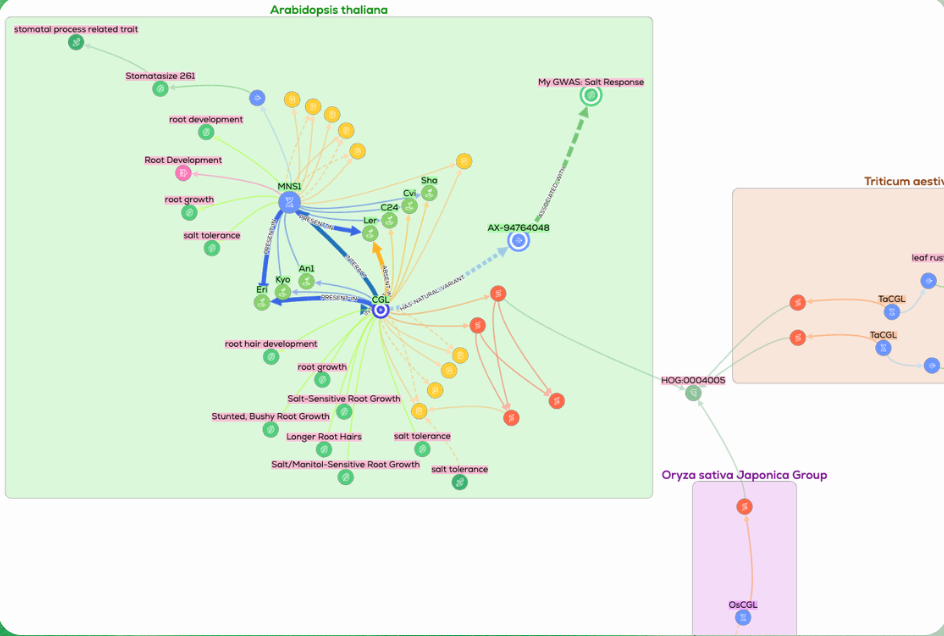
A salt-tolerance use case shows why it matters. Starting from a GWAS peak in Arabidopsis, the integrated graph reveals that the top candidate, CGL, is an accessory gene absent in several of the cultivars studied and weakly conserved in its pan-genomic context (synteny score 0.41) – a risky target for breeding. Its interacting partner MNS1 is present in all of them and highly conserved (0.93), with phenotype evidence linking it to root growth under salt stress. The integration lets a researcher ask harder questions and connect evidence that would otherwise stay scattered across separate resources.
Keywan Hassani-Pak, Head of Bioinformatics at Rothamsted Research, said:
“Pangenomes tell you which genes are present in which varieties, but that only becomes useful when you can connect it to what those genes actually do. By bringing the pangenome data into the KnetMiner knowledge graph, a researcher can take a GWAS peak and see in a single view both the biology behind a candidate gene and how reliably that gene is present across varieties. That is the kind of judgement breeders need to make quickly, and it is what joining up ELIXIR’s plant platforms make possible.”
The outputs are open and reusable. The data is reachable through the KnetMiner REST API and embeddable interactive gene pages, with PAV datasets freely downloadable from the PLAZA FTP server. The PLAZA team plans to add the ability to launch KnetMiner searches directly from a PLAZA instance. KnetMiner, in turn, plans to extend gene presence/absence data well beyond these four species, across its cereals, vegetables, brassicas, legumes and fungi resources.
E-PAN aimed to make plant pangenome analysis more standardised, interoperable and easier to interpret. The project was awarded funding in a Biodiversity, food security and pathogens open call and brought together experts across ELIXIR Belgium, ELIXIR Germany, ELIXIR Portugal, ELIXIR Slovenia and ELIXIR-UK. Michiel Van Bel and Klaas Vandepoele at Ghent University/VIB are co-authors on the interoperability work.
________________________
Find out more
Notes to editors
About ELIXIR-UK
ELIXIR-UK is part of the European ELIXIR infrastructure, which supports life science research and its translation to medicine, the environment, and society. By integrating national bioinformatics resources, ELIXIR-UK aims to provide a sustainable infrastructure for biological information, ensuring that data is effectively managed, analysed and shared across the scientific community.
For further details, reach out to us at contact@elixiruknode.org

